AROEVE MK01 Air Purifier Review (2026)
Updated September 14, 2026 · Research-based review
Our verdict
A compact, budget-priced air purifier for a bedroom or small living room where the main goal is fast filtering rather than smart features. Its 360-degree intake pulls in air quickly for a room up to about 287 square feet, but it has no air-quality sensor, no auto mode, and the top fan speed is noticeable at night.
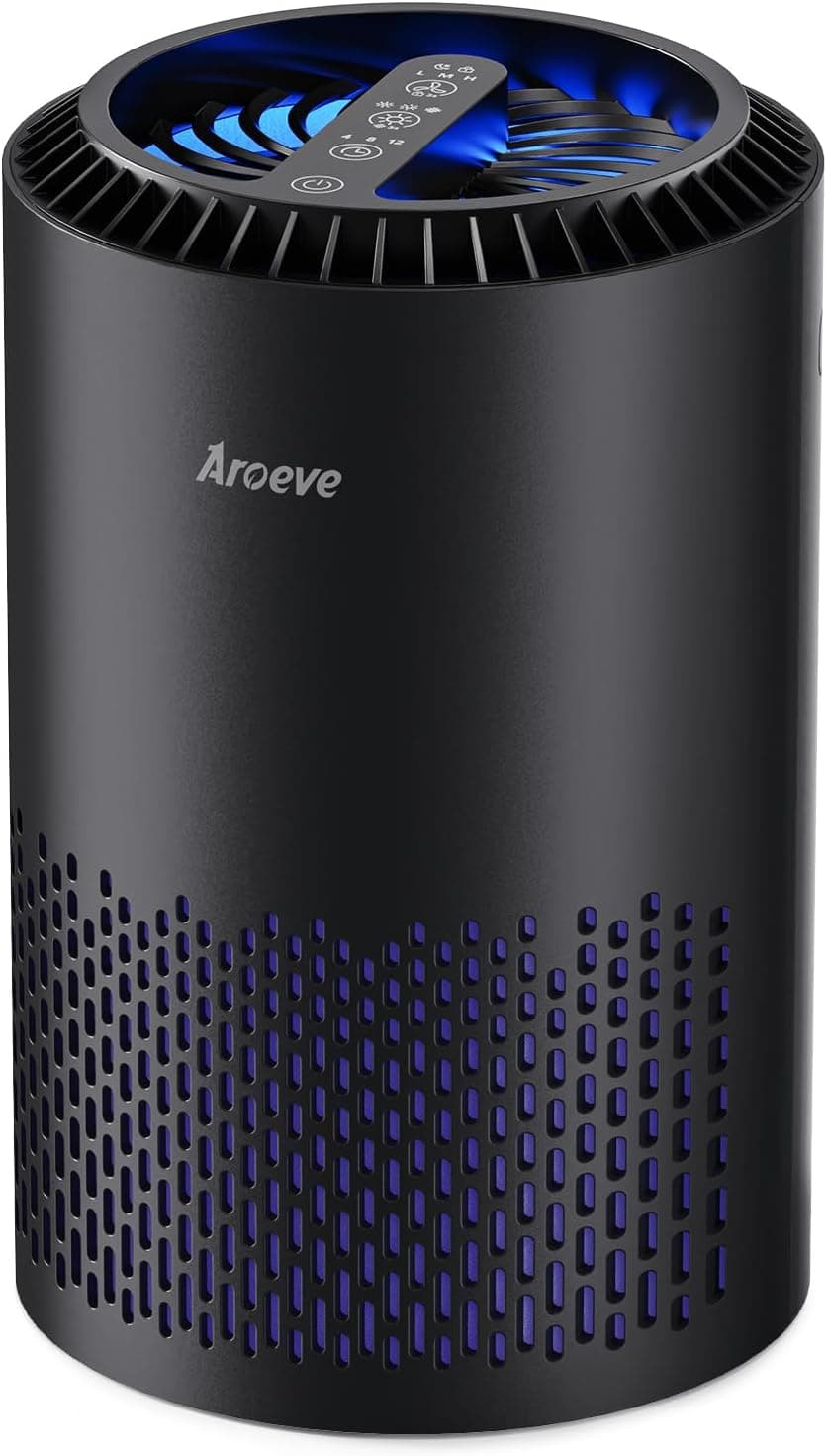
The value pick among small-room purifiers, proven by a huge owner base.
Price range: $$ (Mid-range)
What we liked
- + 360-degree intake cleans a small room fast
- + 42,000+ reviews at a budget price point
- + Compact cylinder fits a nightstand or desk corner
Trade-offs
- - No air-quality sensor or auto mode at this tier
- - Highest fan speed is audible at night
Where this purifier fits in a small home
This is a cylinder-shaped air purifier built for bedrooms, home offices, and other small to medium rooms rather than open living spaces. The manufacturer lists coverage up to about 287 square feet, and the unit itself is compact at roughly 6.1 by 6.1 by 9.7 inches, small enough to sit on a nightstand, desk corner, or floor without taking up much room. It draws air in from all sides through a 360-degree intake design, which is meant to clean the surrounding air faster than a purifier that only pulls air in from one face, making it a reasonable pick for a single room rather than a whole apartment.
What is actually inside and how filtering works
The core filter is an H13-grade HEPA filter rated to capture 99.97 percent of particles down to 0.3 microns, the same efficiency standard used across most HEPA purifiers in this price range, paired with layers meant to catch dust, pollen, pet dander, and hair. The unit has two fan speeds plus a sleep setting, with noise as low as about 22 decibels at the lowest speed. There is a filter-life indicator to flag when a replacement is due, with filters commonly needing changes every three to six months or after roughly 2,000 hours of use depending on air quality in the room, and the manufacturer sells both standard and pet-dander versions of the replacement filter.
Running it day to day
Setup is plug-in and run, with no app or smart-home pairing required, which keeps daily use simple but also means there is no scheduling beyond the built-in speed and sleep settings. Because there is no onboard air-quality sensor, the purifier cannot automatically ramp up or down based on how dirty the air actually is, so you choose the speed manually based on the room and time of day. Owners commonly mention that the top speed setting is audible enough to notice in a quiet bedroom at night, which is why the low or sleep setting is the more common overnight choice even though it moves less air.
Trade-offs against other small-room purifiers
Within its own small-apartment air purifier guide it ranks seventh of eight, well below sensor-equipped models like the Coway Airmega 100, the LEVOIT Core 300-P, and the Winix AM90, all of which add either an air-quality sensor, an automatic mode, or both for roughly a similar or modestly higher price. What keeps it competitive despite the lower feature score is value: a very large installed base of owners at a low price point makes it a common recommendation for anyone who wants straightforward HEPA filtration without paying for smart features they may not use. Anyone who wants the purifier to adjust itself automatically as air quality changes should look at a sensor-equipped model instead.
Who should buy it and who should skip it
This purifier suits a single small bedroom or office where budget matters more than automation, and where you are comfortable manually switching speeds rather than trusting a sensor to do it. The compact size and 360-degree intake make it a sensible pick for a nightstand or desk corner in a studio or small apartment. Skip it if you want auto mode that reacts to smoke, cooking odors, or changing air quality without you touching a dial, or if you are sensitive to fan noise at night and would rather pay more for a quieter top speed or a sensor-driven low setting that rarely needs to run at full power.
Frequently asked questions
What size room does this purifier cover?
The manufacturer lists coverage up to about 287 square feet, making it best suited to a bedroom, home office, or similarly sized room rather than an open living area.
Does it have an automatic mode that reacts to air quality?
No, it has two manual fan speeds plus a sleep setting but no built-in air-quality sensor or auto mode.
How often do the filters need replacing?
The filter-life indicator typically flags a change every three to six months, or after about 2,000 hours of use, depending on how much the unit runs and how dirty the air is.
Is it quiet enough to run overnight in a bedroom?
The lowest and sleep settings run as low as about 22 decibels, but the highest fan speed is noticeable enough that most owners use the lower settings at night.
Prices change often, so check the current price and availability on Amazon.
Check price on AmazonSmall Space Picks may earn a commission from the link above.