Coway Airmega 100 Air Purifier (AQI sensor, Auto) Review (2026)
Updated September 14, 2026 · Research-based review
Our verdict
A compact, sensor-equipped HEPA purifier that suits apartments and single bedrooms rather than open floor plans, thanks to its cylindrical footprint and a real-time air quality sensor that runs the fan for you. The main catch is a non-washable filter that adds a yearly recurring cost on top of a higher upfront price than basic purifiers.
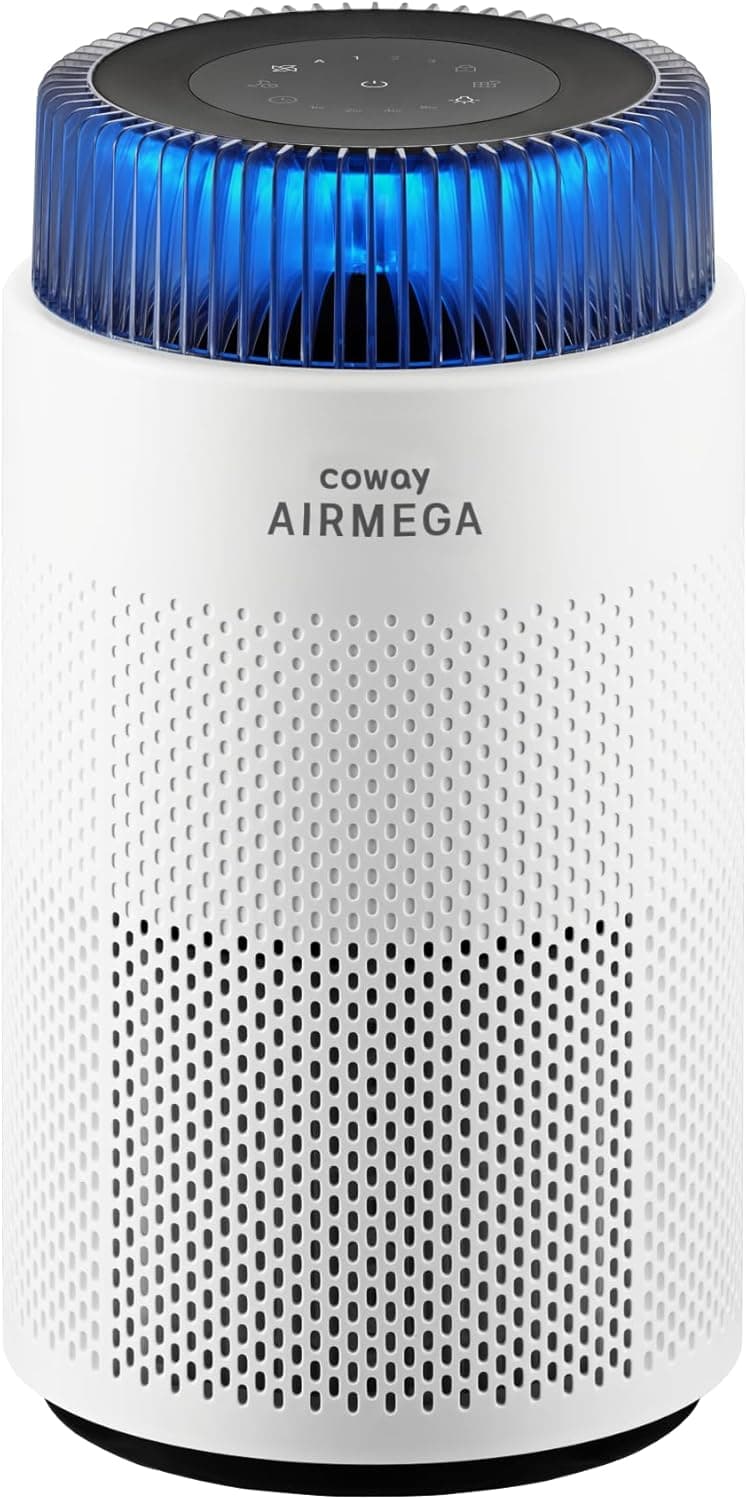
Quiet, sensor-equipped HEPA purifier with auto mode and a compact footprint for apartments.
Price range: $$$ (Premium)
What we liked
- + Built-in PM2.5 air quality sensor with auto mode adjusts the fan automatically
- + Among the quietest in its class with an excellent power-to-CADR ratio
- + Energy Star certified and very space-efficient cylindrical footprint
Trade-offs
- - Non-washable filter must be replaced about once a year
- - Higher upfront price than basic budget purifiers
Who the Airmega 100 fits
Coway markets the Airmega 100 for spaces up to about 810 square feet at one air change per hour, or roughly 405 square feet at the faster two changes per hour that Coway recommends for allergy or pet-dander relief, so it is best matched to a bedroom, home office, or small apartment rather than an open-concept great room. The compact cylindrical housing, at roughly 8.7 inches square and about 15.6 inches tall, is meant to sit in a corner or beside furniture without dominating the room the way a boxier purifier can. Renters and apartment dwellers who want one purifier that can also travel to a different room or a smaller unit later are a good match. Anyone covering a large open living area should look at a higher-CADR model instead, since this one is sized for a single room.
What the sensor and filter specs mean
A built-in PM2.5 particle sensor feeds an Auto mode that raises or lowers fan speed on its own as air quality changes, and a front indicator shows real-time air quality so the fan's activity is not a mystery. Coway lists Clean Air Delivery Rate figures of 108 for smoke, 124 for dust, and 112 for pollen, which describe how quickly the unit can process a room's worth of air for each particle type. Filtration runs through a 3-in-1 stage: a vacuumable pre-filter for larger particles, a HEPA filter rated to capture particles down to 0.01 microns, and a deodorization layer for odors. Coway rates the filter for about one year of typical use, and unlike some competitors' washable pre-filters, this filter set is not washable and needs replacement rather than rinsing.
Setup, daily use, and upkeep
Setup is plug in, remove the shipping film from the filter, and run the initial startup cycle Coway recommends before regular use. Daily operation typically means leaving it on Auto mode so the PM2.5 sensor adjusts fan speed automatically, stepping up during cooking, cleaning, or high-pollen days and quieting down once air quality improves, with manual Speed 1 through 3 settings available for direct control. Coway rates noise from about 20 dB on the lowest setting up to 48 dB(A) at the highest speed, so it is easy to run quietly overnight but audible when working hard. Maintenance is mostly vacuuming the pre-filter periodically to extend the main filter's life, then replacing the full filter set roughly once a year since it cannot be washed and reused.
Trade-offs and how it compares
The most direct cost concern is the non-washable filter, which becomes a recurring annual expense that washable-prefilter competitors avoid, and the unit's upfront price sits higher than basic budget purifiers with similar room coverage. Against the LEVOIT Core 300-P True HEPA Air Purifier, a common rival in the same apartment-size category, the Airmega 100 adds the PM2.5 sensor and Auto mode that the Core 300-P lacks in its base configuration, which is a real advantage for hands-off operation. Against the Winix AM90, a smart auto-sensing purifier in a similar class, the Airmega's tighter cylindrical footprint is easier to tuck into a small room, though the AM90 offers app connectivity that this model does not include.
Bottom line
This purifier is a strong pick for a single bedroom or apartment where hands-off operation and a small footprint matter more than covering a large open space, and where the convenience of an Auto mode with a live air quality readout is worth the annual filter cost. Shoppers covering a larger room, or who specifically want a washable pre-filter to cut ongoing costs, should compare a higher-CADR or washable-filter model before buying. Our score of 8.2 out of 10 reflects strong fit for apartment-size rooms with a fair, if not budget, value proposition.
Frequently asked questions
What size room does the Airmega 100 cover?
Coway rates it for up to about 810 square feet at one air change per hour, or about 405 square feet at the faster two changes per hour recommended for allergy relief.
Can the filter be washed and reused?
No, the pre-filter can be vacuumed to remove surface dust, but the full HEPA and deodorization filter set is not washable and needs replacement about once a year.
How loud is it on the highest setting?
Coway rates noise from about 20 dB on the lowest speed up to 48 dB(A) on the highest speed, so it stays quiet for most everyday use but is audible at full power.
Does it adjust itself automatically?
Yes, a built-in PM2.5 sensor drives an Auto mode that raises or lowers fan speed based on real-time air quality, with manual speed settings also available.
Prices change often, so check the current price and availability on Amazon.
Check price on AmazonSmall Space Picks may earn a commission from the link above.